Basket Summary
There are no more items in your basket
By Type
GUIDES · INTERIORS
If you choose the right combination then a living room has a carefree appearance, but if you select the wrong one the most attractive sofa can seem a bit out of place.
Picking an incorrect combination of sofa and wall colour can greatly influence how a room appears; it might turn a room that ought to be relaxing and well-coordinated into one which seems disconnected, even if each individual item is of good quality. The key to finding the right match is not to stick to rigid rules but rather to grasp a number of simple principles which make colour selection easier. The following guide shows how to match a sofa with your wall paint colours, covering everything from the traditional 60/30/10 rule to the best wall colours for each sofa shade.
In this article
I. How to match a sofa to paint colours
II. Should you decide first about your sofa or about the paint?
III. Understanding warm and cool undertones
IV. The best wall colours for every sofa colour
Begin with the colour scheme that you currently have, not with the new one. The sofa should match your existing walls, floor and furniture, not clash with them. It's worthwhile to order fabric samples and hold them up against your walls at various times of the day—the effect of natural light in the morning can be quite different from that of lamplight in the evening, and a colour which looks perfect on a screen can change completely once it's in your room.
When choosing colours, interior designers often follow a 60/30/10 rule:
Sixty percent of the room should be occupied by your main colour, this usually being the walls and the floor.
Thirty percent of the room consists of a secondary colour – usually the sofa and the other big pieces of furniture.
Ten percent of the room should be given over to an accent colour — for example, the cushions, throws and lamps.
Since the sofa is generally in the 30% category, it should coordinate with both the main wall colour and the smaller accent colours as well. A sofa that meets all three criteria will seem genuinely thought out rather than just matching.
Whenever possible, it is almost always simpler to select your sofa first since it is usually the largest piece of furniture in the room and it is much more difficult to replace a sofa than it is to repaint a wall. If that isn't possible—for example, if you are moving into a house where the walls are already painted or if you don't currently have a sofa to work around—you can still decide on your ideal colour scheme first and just ensure that the colour of your sofa fits within the 60/30/10 rule when you eventually buy it.
Under the main shade of any paint colour or any fabric colour there is a tint—either a slight warmth or a slight coolness—that influences the way the two go together.
Warm undertones are inclined to be yellow, red, or brown and have the effect of making a room seem cosy, welcoming and lived-in. This group includes warm neutrals, terracottas, warm greens and rich browns.
Tones that are cool tend to be blue, green, or grey and generally make a room seem more calm, fresh, and modern. Typical examples of cool tones are cool greys, blues, and sage green. Cool, light tones like these are also a good choice if you want your walls to make a room look bigger, since they recede visually and help a smaller living room feel more open.
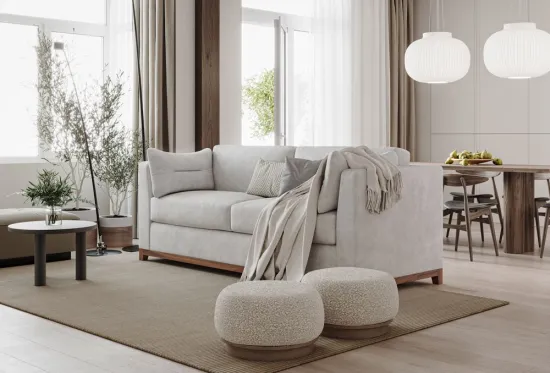
One of the easiest ways to create a truly cohesive and relaxing area is to match the undertones of your sofa, the walls and the other furniture; it is often the case that mixing warm and cool tones too freely makes a room seem slightly "off", even if each item looks acceptable on its own.
The colour of the walls suits different colours of sofas, and below are some guidelines for the most commonly seen sofa shades.
Grey is one of the most versatile colours available for sofas. Sofas in warm white or soft greige make the room seem bright and modern, whereas a deeper charcoal or navy colour on the walls gives a real sense of drama when placed behind a lighter grey sofa. As accents, both blush pink and warm mustard enhance a grey scheme very nicely.
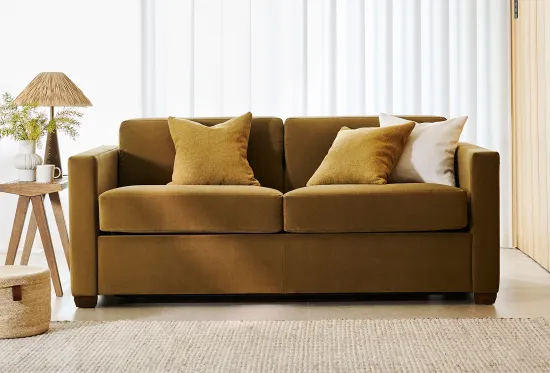
Brown sofas go well with warm neutral colours — warm whites, soft stone, and gentle taupe all allow the grain of the wood and the texture of the fabric to become the focal point. If you want something more striking, a wall in deep forest green or burnt orange beautifully enhances the warmth of brown.
Blue sofas go very well with warm whites and soft greiges to produce a calm and classic appearance, or with a deeper navy or teal wall to create a more enveloping, toned scheme; mustard and blush accents both provide a pleasant contrast.
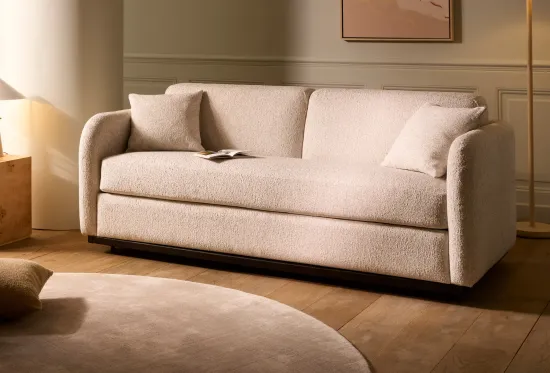
Sofas in beige and neutral tones are the most convenient to use, as they match well with almost any wall colour, whether it's a bright white or a bold, dark feature wall. It's an excellent choice if you like to frequently change your accent colours, since the sofa itself will never clash.
Green sofas, especially those in sage and olive colours, look very well beside warm whites and soft, chalky neutral shades. If you want a more toned appearance, combine a green sofa with walls that are a subdued terracotta or a warm stone colour.
Red is a true statement colour, and in that case it's usually advisable to combine it with a more subdued wall colour—warm whites, soft greiges, or a gentle stone all allow the sofa to take the focus without competing with it.
Soft pink sofas go very well with warm whites and gentle greiges to create a soft and romantic atmosphere, or they can be matched with a deeper sage green or navy-coloured wall for a more mature and contemporary appearance.
Black sofas are bold enough to go well with almost any wall colour, whether it's a crisp white for maximum contrast or a warm taupe or terracotta for a more subtle and layered appearance.
When people are selecting colours, a number of common mistakes keep occurring. Here are some of them to watch out for.
As a general rule of thumb, it's safer to choose a wall colour that's a shade or two lighter or darker than your sofa rather than an exact match — too close a match can make a room feel flat, while enough contrast keeps the two elements distinct and adds depth.
A simple method of making a small living room appear larger and more unified is to apply a colour wash—that is, to paint the walls, ceiling and wooden furniture the same colour so that the eye doesn't encounter any abrupt transitions. This technique is particularly effective in rooms with odd angles or low ceilings, since a great deal of contrasting trim can make such a space seem more crowded and smaller than it actually is.
We applied this method in our own living room by painting the entire room Farrow & Ball Tailor Tack and combining it with a storage sofa as well as open shelving in order to give the room a calm and clutter-free appearance. For more information on selecting a sofa for your living room, or to find out how we dealt with wall colour, see our guide on what colour to paint your walls.
Ready to put it all together?
Want to see how one of our sofas would look with your colour scheme? Order some free fabric samples or visit one of our London showrooms to see our products and your favourite colours in real life.