



Basket Summary
There are no more items in your basket
By Type
GUIDES · STORAGE BEDS
Two names, one product. What actually differs between storage bases, from the people who build them in Nottingham.
Here is the plain truth. A storage bed and an ottoman bed are two names for one product. Retailers use the terms interchangeably, and "ottoman" in this context describes the gas lift mechanism rather than a separate category of bed.
Shoppers spend hours comparing the two, convinced they face a choice. They do not. The word "ottoman" originally described a padded footstool with a hinged lid. The bed industry borrowed the name for beds whose mattress platform lifts to reveal storage underneath. Somewhere along the way, listings split into "ottoman beds" and "storage beds" as if these were rival designs.
We make these beds by hand in our factory in Nottingham. We have watched customers walk into our showrooms asking which of the two is better. The honest answer is that the question dissolves once you know the vocabulary.
So let us settle it, then move to the question you actually meant to ask: what kind of storage base do you need?
The furniture trade has never agreed on naming conventions. One retailer lists a gas lift bed as an ottoman. Another lists the identical construction as a storage bed. A third uses both terms on the same product page.
The result is a shopper comparing a product against itself and assuming the price difference reflects a design difference. Usually it reflects nothing more than the retailer's word choice.
There is one genuine distinction hiding underneath the muddle, and it matters far more than the label. It is the difference between a full lift base and a divan base with drawers.
A full lift base is what most people picture when they say ottoman or storage bed. The entire mattress platform rises on gas struts, and the whole footprint under the mattress becomes one large, uninterrupted compartment. Nothing divides the space. You store items directly on the base board.
A divan with drawers is a different construction entirely. The base is a solid box with two or four drawers built into the sides. Nothing lifts.
Capacity is where they part company. Because the lifting platform frees the complete base area, a full lift bed offers significantly more storage than a divan with drawers. You can lay a full suitcase flat. Ironing boards, vacuum cleaners, spare bedding, seasonal wardrobes and even a boxed Christmas tree fit under a well designed lifting base. Access works vertically: you lift, you look down at everything at once, and nothing needs floor space to slide out.
Drawers give you compartments instead, which suits people who want socks in one place and linens in another. They also need no strength to operate, which matters for anyone who finds lifting a mattress platform difficult. But the drawer mechanism consumes internal space, so usable storage is a fraction of the bed's footprint, and drawers need clear floor space to open. A bedside table or a wall placed too close blocks them permanently. That detail is commonly overlooked until the bed is already in the room.
We build storage beds for a living, and we will still say this: if your bedroom has generous wardrobe space, or the area under the bed would sit empty, a plain frame is cheaper, lighter and simpler. Storage bases earn their price when you have things to store and nowhere else to put them.
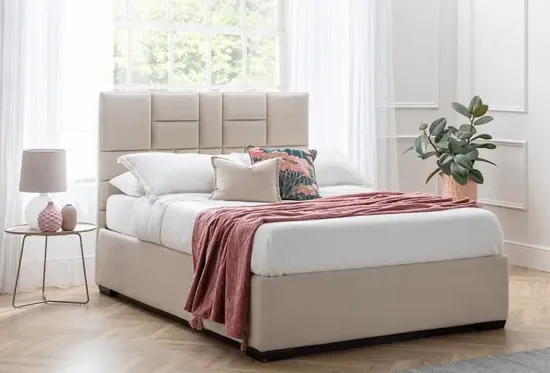
The Hotel storage bed: lift the base and it is all there.
Once you have settled on a full lift base, one genuine choice remains. The platform can lift from the foot of the bed or from the side.
End lift is the standard configuration. You stand at the foot of the bed and raise the platform towards the headboard. It works when you have clear space at the foot of the bed to stand in.
Side lift raises the platform from one long edge. It suits rooms where the foot of the bed sits close to a wall, a wardrobe or a door swing.
The deciding factor is your room layout, and specifically which side of the bed sits against a wall. Sketch the room before you order. Measure the clearance where you plan to stand while the platform is raised. A lifting base you cannot comfortably open becomes an ordinary bed with a hidden cavity you never use.
The gas strut is the working heart of a lifting base, and it is the specification retailers mention least. Struts are rated in Newtons, and the rating needs to correspond to the weight of your mattress. The scale we use in our own factory in Nottingham is a useful benchmark:
These are the ratings we specify on our own beds, so this comes from manufacturing experience rather than a retailer's product page.
If the load is too light for the struts, the platform can drift upward or refuse to stay down. If the load is too heavy, the system strains, jams or fails early. Larger beds sometimes need two sets of mechanisms for stable, even lifting.
This matters because mattresses vary enormously. A heavy pocket sprung king size mattress weighs far more than a foam double. The same base that lifts one effortlessly will struggle with the other. Before you buy, weigh two facts against each other: your mattress weight and the strut rating of the base. Any manufacturer worth your money will tell you both. If a retailer cannot answer, that silence tells you something about the engineering behind the product.
There is a point where no strut is the right answer. If you have bought a Vispring, a TEMPUR or another premium mattress, you may be asking a gas mechanism to lift something it was never rated for. This is the single most common reason people are told they cannot have a storage bed at all.
They can. An electric base replaces the gas struts with a motorised mechanism and a remote control. The platform rises and lowers at the touch of a button, and the weight of the mattress stops being the deciding factor. It is also the answer for anyone who finds lifting difficult for any other reason, or who simply does not want to heave a platform every time they need a suitcase.
This is worth knowing before you compromise. A heavy mattress is usually a good mattress, and choosing between the mattress you want and the storage you need is a false choice. There is still a limit to what any bed can carry, so if yours is particularly heavy it is worth asking the manufacturer directly rather than guessing. We have written about this in more detail in our guide to storage beds for heavy mattresses like TEMPUR and Vispring.
Storage depth is where beds that look identical in photographs part company. Across UK lifting bases, internal depth typically ranges from 20cm to 40cm. At 33cm of internal depth, a double base (135cm x 190cm) holds around 850 litres, a king (150cm x 200cm) around 990 litres, and a super king (180cm x 200cm) exceeds 1,190 litres.
A few centimetres sounds trivial. Spread across the full footprint of a double or king, it decides whether a suitcase lies flat with room to spare or has to be forced in at an angle. A large checked suitcase is typically around 28cm deep lying flat, so a base with genuine internal depth swallows it cleanly and still leaves room for off-season clothing packed inside. Our own storage beds offer up to 40cm of depth, the top of that range, because shallow storage bases disappoint people once the novelty wears off.
When you compare beds, ask for the internal depth in centimetres, measured from the base board to the underside of the platform. External height tells you nothing. Some tall bases hide shallow compartments above thick framing.
Four suitcases, shoes and books, all under one bed.
The strength of a lifting bed depends on more than the strut rating. Base board thickness, frame construction and corner reinforcement together determine how the bed performs under sustained weight over years of nightly use.
Remember what the base carries: the mattress, two sleepers, and everything stored below. A thin base board sags under a loaded suitcase. A weak frame develops play at the joints, and the platform stops sitting square. Ask what the frame and base board are made of and how thick they are. As a manufacturer, we can tell you that these are the questions that separate beds built to last from beds built to a price.
You need clearance to open the bed. An end lift needs standing room at the foot. A side lift needs it along one edge. Bedding and cushions rise with the platform, but items on a footboard or side table will not.
Mattress weight affects daily use. Correctly rated struts do most of the work, and the platform should rise with light effort and lower gently. A mattress far heavier than the rating makes every opening a chore, and a chore is something you stop doing. The storage then goes unused. An electric base removes this problem entirely.
The floor under the bed stays sealed. With a full lift base, the storage compartment sits on a solid board, which keeps dust off your belongings. Slatted open frames with under bed boxes offer no such protection.
Assembly and access matter in small rooms. Check that the bed arrives in sections that fit through your hallway and up your stairs. A bed that cannot reach the bedroom stores nothing.
Forget "storage bed or ottoman bed". They are the same product wearing two name tags. The questions that decide whether you will be happy in five years are these.
How much do you need to store, and in what shape. Bulky items favour a full lift base. Small categorised items suit drawers, provided the drawers can actually open in your room.
Which walls touch your bed. That answers side lift versus end lift before any brochure does.
How heavy is your mattress, and what strut rating does the base carry. Match them. If the mattress is very heavy, an electric base removes the question altogether.
How deep is the compartment, in centimetres. Between 20cm and 40cm is the range on the UK market, and the top of that range holds meaningfully more.
What is the base built from. Thick boards and reinforced frames carry weight for decades. Thin ones do not.
We founded Furl in 2007 to solve exactly these problems, and we build every bed by hand in Nottingham as a certified B Corporation. Our advice stands regardless of where you buy. Measure your room, weigh your mattress, ask for the internal depth, and ignore the label on the product page. The name on the bed matters far less than the engineering inside it.