
Basket Summary
There are no more items in your basket
By Type
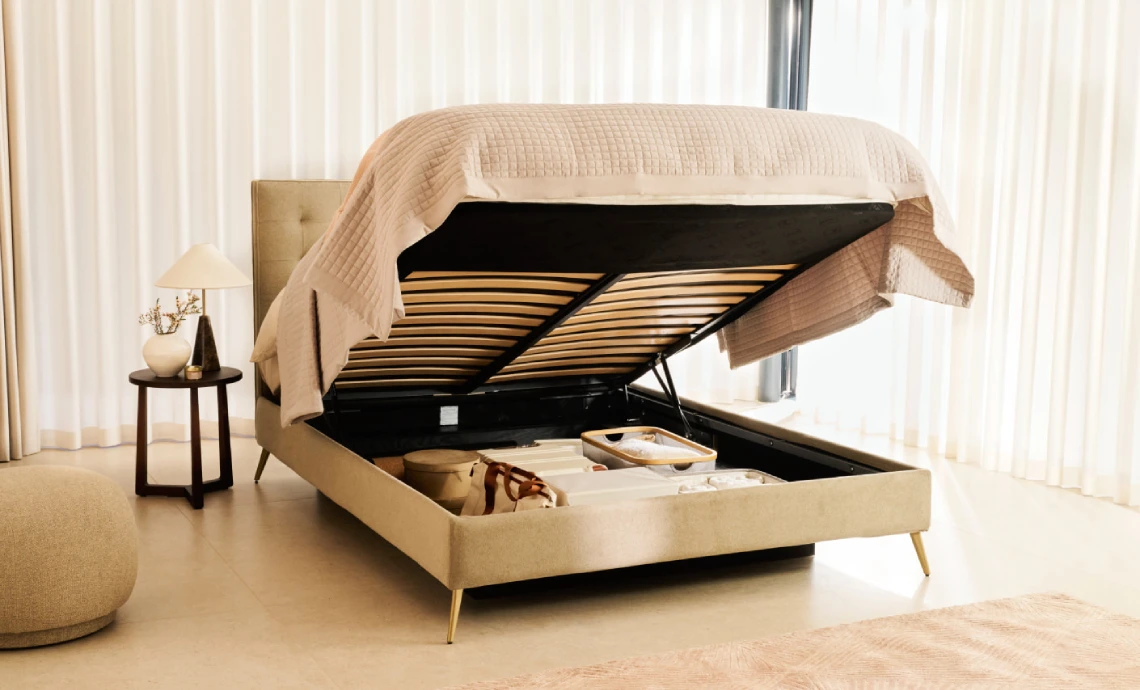
A room that breathes. Underfloor heating removes the radiator; a Furl storage bed removes everything else.
Underfloor heating is one of the quiet revolutions in British homes. It's in nearly every new-build flat, it's creeping into renovations, and — if you've ever stepped out of bed onto a warm floor on a January morning — you'll understand why.
But it raises a question we hear almost every week in our showrooms: can I put an ottoman bed on top of it?
The short answer is yes. The longer answer is that underfloor heating and ottoman beds are, in a quiet way, doing the same job. They're both removing clutter from the room.
A radiator is a large, warm, opinionated object bolted to one of your walls. It dictates where the bed can go. It dictates where the wardrobe can go. It pushes furniture out into the middle of the room. In a small London bedroom — which is most London bedrooms — a single radiator can be the difference between a room that breathes and a room that doesn't.
Underfloor heating removes that object. The wall is suddenly yours again. You can push the bed flush against it, hang a picture where the thermostat used to be, put a chair in the corner the radiator was hogging.
This is the same logic that brought you to an ottoman bed in the first place. You wanted your suitcases, your out-of-season clothes, your spare bedding to disappear — so the bedroom could feel like a bedroom rather than a storage cupboard with somewhere to sleep in it.
An ottoman bed makes things vanish upwards into the base. Underfloor heating makes the radiator vanish into the floor. Put them together and you've reclaimed the walls, the floor, and the visual noise all at once.
That's the aesthetic case. Here's the technical one.
There's a lot of hand-waving online about underfloor heating and furniture. Most of it is either too cautious ("avoid all furniture") or too casual ("it'll be fine"). The honest answer sits between the two, and it comes down to three numbers worth knowing.
Carpet + underlay tog
Under 2.5. Combined thermal resistance of carpet and underlay. For heat-pump systems, aim for 1.5 or lower.
Clearance under the bed
Around 10cm. Air gap under any large furniture — two to three inches is the standard industry figure.
Floor surface temperature
Max 27°C. Controlled by the heating system, not the bed. Tile can go a degree or two higher.
If your bedroom has (or will have) carpet over the underfloor heating, the combined thermal resistance of the carpet and underlay matters. The figure the whole UK underfloor heating industry has settled on is 2.5 tog — tested by the Underfloor Heating Manufacturers' Association at BSRIA, and quoted by Cormar, Brintons, Nu-Heat, Danfloor and every major carpet brand worth trusting. Above that, heat struggles to get through. Below it, the system runs happily. If your underfloor heating is powered by a heat pump rather than a conventional boiler, aim for 1.5 or lower.
Your carpet supplier will know the tog rating of their ranges. Ask them, and ask about the underlay too — it's the underlay that trips most people up.
Underfloor heating works by warming the floor, which warms the air, which warms the room. If a piece of furniture sits flush to the floor with no air gap underneath, that air can't circulate — and you end up with a warm patch trapped under the bed rather than flowing around it. Industry guidance is consistent: a minimum of 2–3 inches (roughly 10cm) between the floor and the underside of the bed, to allow air to move freely.
This is where the design of your bed starts to matter — and where Furl has a genuine advantage. More on that below.
This one isn't about the bed — it's about the heating system. Underfloor heating surfaces shouldn't exceed 27°C, controlled by a floor sensor thermostat (tile and stone floors can go a degree or two higher). Any competent installer will set this up for you. We mention it only because people occasionally worry their bed will be exposed to unreasonable heat. It won't.
It's the question nobody in the bed trade answers honestly, so here it is: yes, a bit. Industry figures suggest that if around 20% of a room's floor is blocked by furniture, usable heat output from that zone can drop by roughly 30%. It's not a catastrophe, but it's real — and worth knowing before you design the room.
Here's what that means in practice.
Your underfloor heating installer calculates how much heat your bedroom needs based on the room itself — its size, insulation, windows, how many external walls it has. That number doesn't change when you add furniture. What changes is the amount of floor available to deliver that heat. Cover more floor, and the exposed portion has to work a little harder.
Most installers plan for this by excluding fixed furniture from the heated area — kitchen units, baths, built-in wardrobes. Professional design software does this automatically. Free-standing furniture like beds and sofas sits in a grey zone, because it can move, and most bedrooms naturally have enough uncovered floor that it isn't a problem. A typical bedroom with underfloor heating is designed for around 60–75% carpet coverage anyway — the bed accounts for a meaningful chunk of the remaining floor area.
If your system isn't yet installed, mention the bed's footprint to your installer early. Some designers will actively exclude the area under the bed from the heated zone — saving energy and avoiding any concern about heat output in that zone. It's a one-minute conversation that pays off for years.
If your system is already installed, a raised, ventilated bed base makes a noticeable difference. Heat that would otherwise sit beneath a flush plinth instead rises and circulates, putting that floor area back to work. This is exactly what our optional ventilated base is designed for.
A fair question, and worth answering directly rather than hand-waving. Customers sometimes worry that stored belongings will "cook" under a bed that sits on the floor. The honest answer is no — and the physics is genuinely reassuring once you see it.
Underfloor heating caps floor surface temperature at around 27°C. That's a hard ceiling, enforced by the floor sensor thermostat. The air inside a bed's storage cavity will, over time, equalise with the floor temperature below it. So whatever is stored inside sits at somewhere in the low-to-mid twenties.
Which is cooler than you probably think.
For context — real-world temperatures
| 40°C+ | Car parked in mild sun |
| 35–40°C | Linen cupboard next to a hot water tank |
| 27°C | Maximum UFH floor temperature |
| 22–26°C | Inside a storage bed on UFH |
| 24–28°C | Warm summer's day in London |
| 18–21°C | Typical heated British bedroom |
That's well within the safe range for clothes, bedding, luggage, shoes, paperwork, books — anything you'd reasonably store under a bed. The caveats are narrow and mostly obvious. Candles will soften. Chocolate shouldn't live there (it shouldn't live under any bed). Medicines labelled "store below 25°C" should be kept elsewhere. Vinyl records if you're that kind of collector. Otherwise, your belongings are genuinely fine.
One thing worth adding: every Furl storage bed is built with ventilation as standard. The internal compartments are designed to allow airflow around stored items, which helps prevent moisture build-up and keeps everything in there in good condition. It's not marketing — it's engineered in.
What the cavity doesn't do as well is move heat up into the room. A bed with a plinth on all four sides has limited airflow underneath it, which means energy entering that section of floor doesn't circulate into the bedroom as efficiently as open floor area elsewhere. That's the efficiency question we covered above. It isn't a safety issue. It's a performance one.
The floor covering on top of your underfloor heating makes a real difference to how the system behaves around furniture. Worth knowing before you choose a bed.
Tile or stone (ceramic, porcelain, natural stone) is the ideal combination with underfloor heating, and the most forgiving with furniture. Both ceramic and porcelain have a high level of thermal conductivity, so warmth from the system is quickly and efficiently dispersed into the room. Tile also distributes heat sideways through its own thermal mass, which means warmth doesn't get trapped under a bed in the way it can with softer coverings. If you have ceramic or stone over your underfloor heating, most Furl beds will work well without any special adjustment.
Engineered wood is a good partner too, though wood isn't as efficient a conductor. Warm-up times are longer, and your installer will typically cap the floor surface temperature at around 27°C to protect the boards. Beds sit happily on engineered wood over underfloor heating — the same clearance principles apply.
Carpet is where the 2.5-tog rule really matters, and where the case for a raised, ventilated bed base is strongest. Carpet insulates — and a floor-level bed construction on thick carpet can create exactly the kind of warm pocket the industry guidance asks you to avoid.
Here's where we can be genuinely useful. Our range splits roughly down the middle between two construction styles, and either can be adapted for underfloor heating — because every Furl bed is made to order in our UK workshop.
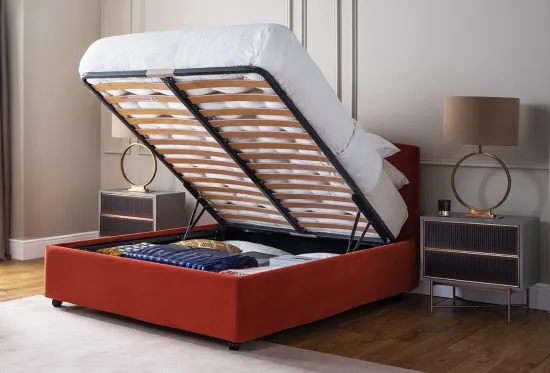
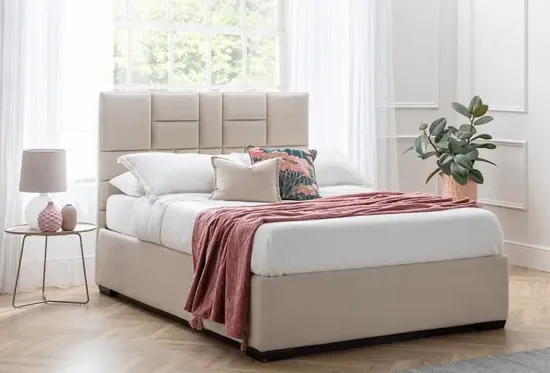
Simplicity Raised · On castors |
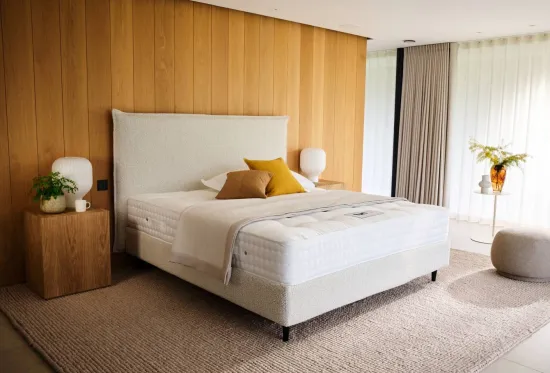
Air Raised · On feet |
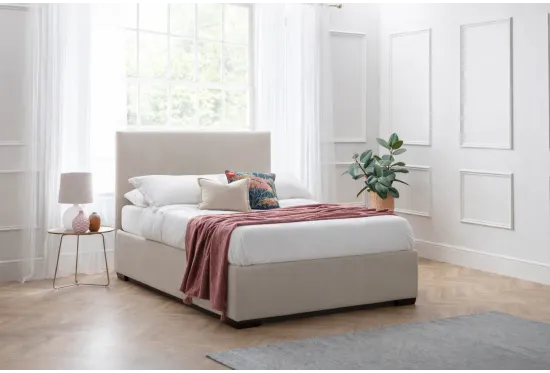
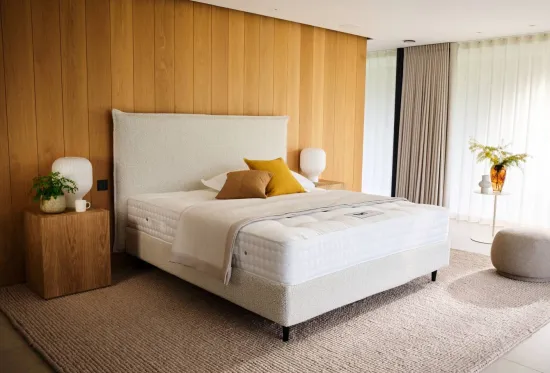
Max Floor-level · Plinth |
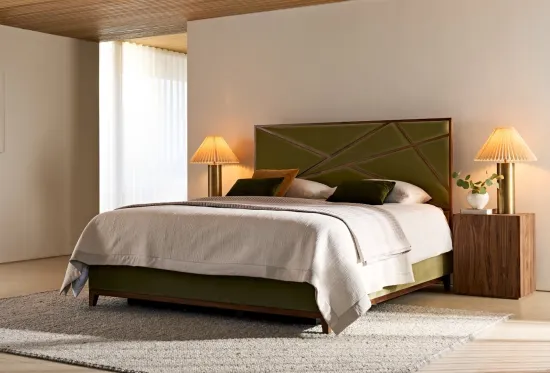
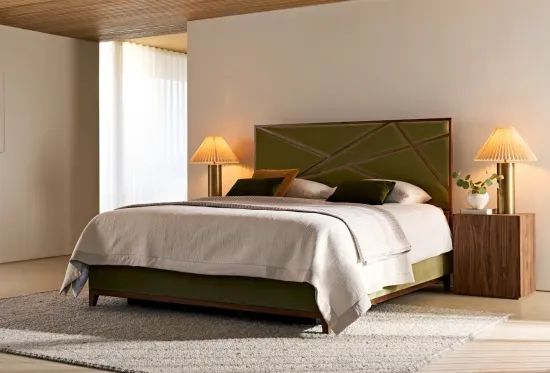
Illusion Floor-level · Wood detail |
Simplicity sits on castors with a 40cm bed height and a clear gap beneath. Air sits on slim feet with a light, lifted silhouette. Both lift the base off the ground with a clear air gap underneath the full footprint — heat circulates exactly as your underfloor heating system expects it to. If you're drawn to one of these designs already, you don't need to do anything different.
Our wooden range also includes Air Wood, with the same raised construction in FSC oak or walnut.
Max, Mini Max and Illusion use a hidden plinth or timber-detail base around the outside of the bed, with items inside resting on a ventilated liner at floor level. This is brilliant for storage volume — it's how Max squeezes up to 40cm of storage depth into the same footprint as an ordinary bed. The trade-off is that the plinth walls off airflow underneath the bed.
For most bedrooms this isn't a real-world problem — our founder David has used Max over underfloor heating at home for years, with no impact on the bed or the heating. But if your developer has specified a minimum clearance, or if the bed covers most of the floor area in a small room, there's a better option.
Any Furl bed can be built with an optional raised base with ventilation instead of the standard floor-level construction. This lifts the whole bed on solid wooden legs, with an open base that lets heat circulate freely underneath. You keep the look of the bed you wanted. You keep the storage capacity. You just get a construction that's purpose-built to work with underfloor heating.
It's made to order with the rest of your bed, in the same 6–8 week lead time. Just tell us when you request a quote, and we'll build it in.
Not really. An ottoman bed — one that lifts on a gas piston to reveal storage — has exactly the same footprint on the floor as a fixed-base storage bed. The lift mechanism itself doesn't change airflow underneath or heat distribution around the bed. What matters is the construction of the base, which is what we've covered above.
What doesn't work over underfloor heating is a standard divan that sits flush to the floor with no feet at all. Closed-bottom furniture is specifically flagged by industry guidance as the configuration to avoid on radiant heating. All Furl storage beds either sit on feet or offer the ventilated-base option, so this isn't something you'll run into with us — but it's worth knowing if you're comparing our beds against a conventional divan.
—Ask your developer or underfloor heating installer if they've specified a minimum bed clearance.
—If your bedroom will have carpet, check the combined carpet-and-underlay tog is 2.5 or below.
—If your system isn't yet installed, ask the designer to exclude the bed's footprint from the heated area — it improves efficiency and avoids any hotspot concern.
—Tell us at the point of quote that you have underfloor heating — we'll flag any adjustments.
—If you're buying off-plan and the flat isn't finished yet, send us the floor plan and we'll talk it through.
Underfloor heating and ottoman beds are both, at heart, about getting things out of the way. The heating goes under the floor. The suitcases go under the bed. The radiator disappears. The clutter disappears. The room exhales.
That's the bedroom Furl has always been trying to help people build. Underfloor heating just happens to be a very good partner in the project — and because every one of our beds is made to order in the UK, we can adapt the construction to suit your system, your room, and the way you actually live.
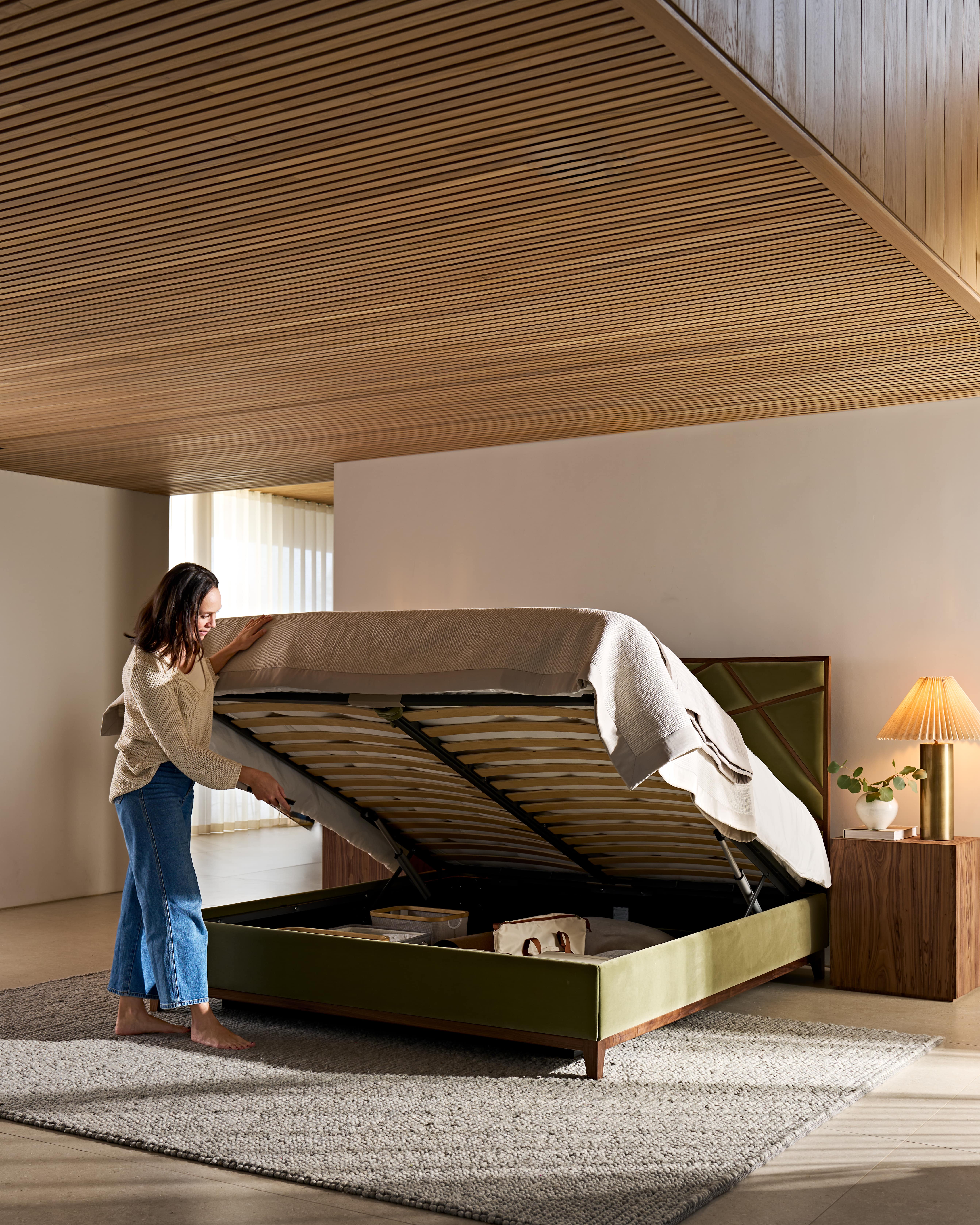
Smaller footprint, more space. A calmer room is the whole point.
Advice for your room
Underfloor heating, carpet, tile, off-plan, finished — whatever the setup, our team will talk you through it before you commit.
Unfurling our best wishes.