Basket Summary
There are no more items in your basket
By Type
There is a particular frustration that belongs to modern living — the sense that your home is just slightly too small for the life you want to live in it. Not dramatically so. Just enough to require compromises you’d rather not make.
British homes are, on average, among the smallest in Europe. That is not a new observation — but what has changed is the scale of what those homes are expected to do. A living room today is asked to be a workspace, a dining room, a lounge, and occasionally a guest space, often all within the same square footage that, twenty years ago, would simply have held a sofa and a television.
The furniture industry has, by and large, responded with two inadequate answers: very small furniture, or very complicated furniture. The first sacrifices function. The second sacrifices form. Neither quite resolves the tension between wanting a space that feels considered and a life that refuses to stay still.
The more interesting question — the one that preoccupies the better designers working in this space — is not how to make furniture smaller. It is how to make fewer pieces do more, without any of them looking like they’re trying.
The Pivot began, in design terms, with a simple premise: most compact homes cannot accommodate both a coffee table and a dining table without one of them feeling like an afterthought. So what if they were, quietly and elegantly, the same thing?
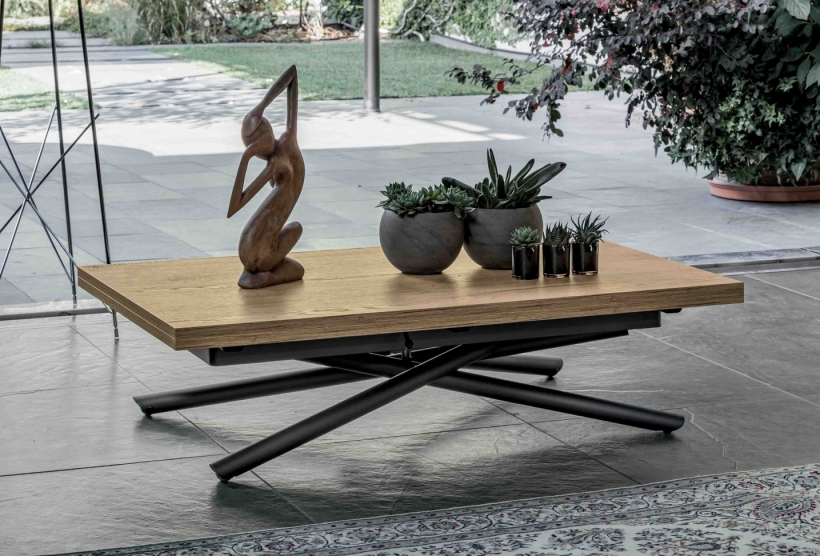
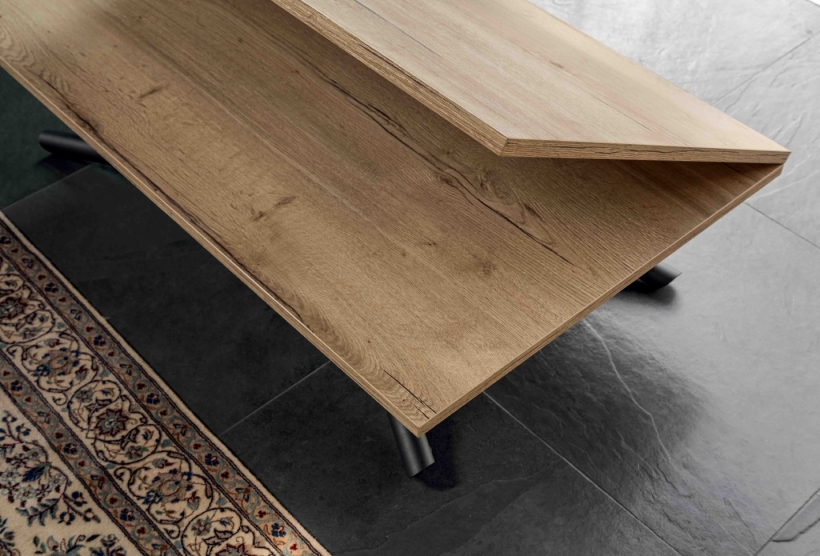
This is an extending coffee table — one that converts to a dining table for six — but that description undersells it in the way that calling a great coat “something to keep you warm” undersells it. The Pivot is a proposition about how you live, not merely a product that fits in your living room. It starts low, sitting naturally at coffee-table height, with the kind of proportions that allow a room to breathe around it. Then, when the day demands it, it rises.
The transformation is not a trick. There is nothing theatrical about it. It simply changes, smoothly and without ceremony, from one thing into another — the way good design almost always does its most important work.
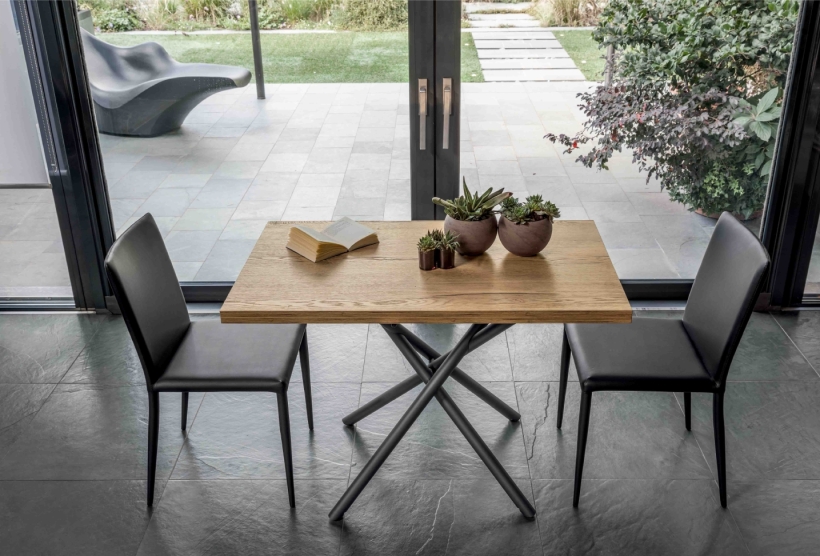
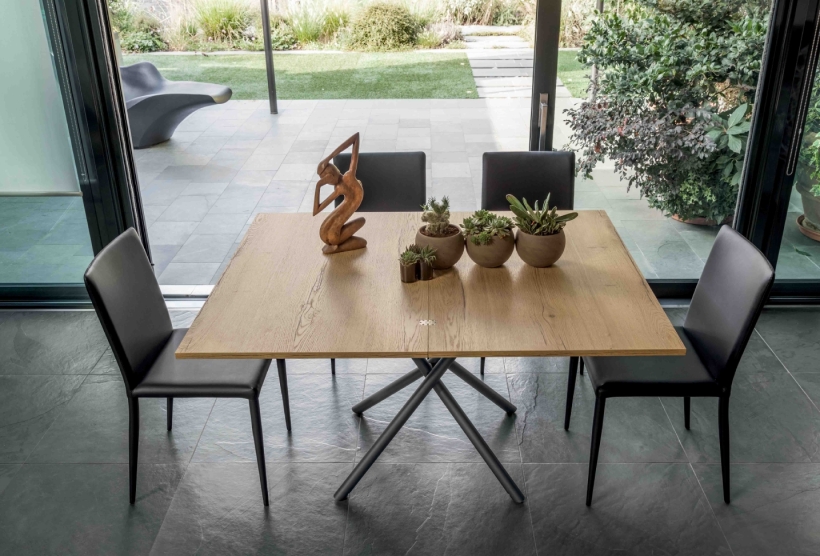
One of the persistent criticisms of multifunctional furniture — and often a fair one — is that it looks multifunctional. There is a visual busyness to it, a sense of latent machinery, of potential not quite concealed. The room becomes a waiting room for a transformation that never quite settles into either state with real confidence.
The Pivot sidesteps this through proportion and restraint. At coffee-table height, it reads as precisely that: a low, clean-lined surface with a presence that is calm rather than assertive. The engineering is entirely concealed; the steel frame, solid and unmoving, offers no visual clue to what it can do. It sits in a room the way well-chosen furniture should — as if it has always been there, as if it belongs.
The surface finishes — available across a considered range of durable melamines — are chosen to complement rather than compete. Nothing announces itself. Everything simply is.
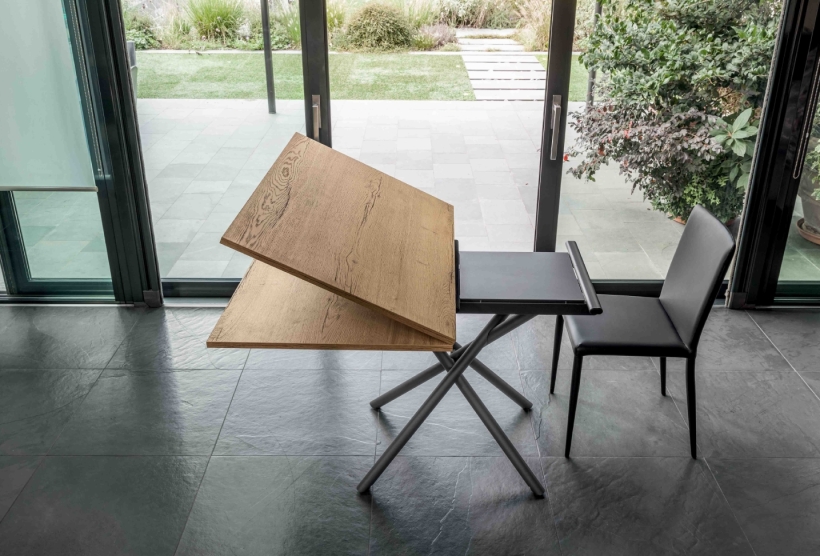
There is a moment, when you use the Pivot for the first time, where the mechanism surprises you. Not because it does anything unexpected — it does exactly what it promises — but because of how it feels. The gas-assisted lift is controlled and gradual, with none of the uncertainty you might expect from a table that is, in effect, changing its fundamental nature. You place a hand on the surface. You guide it upward. It rises with you, evenly and without resistance, until it reaches dining height and holds there with the quiet confidence of something that was built properly.
The extension of the tabletop follows the same logic: unhurried, considered, requiring no particular effort or expertise. Integrated castors allow you to reposition the table first, then lock it into place. Nothing wobbles. Nothing gives. The solid steel frame, which carries all of this, remains as stable at full dining height as it is at its lowest — which is to say, completely.
A Saturday morning. Coffee, a book, the unhurried quality of a morning with no particular schedule. The Pivot sits low — close to the sofa, accessible, part of the room rather than imposing on it. A mug, a newspaper, the easy landscape of an undemanding day.
By mid-morning, a laptop appears. The surface is generous enough, the height precisely right for working without hunching. No secondary desk required. No compromise with the room’s sense of calm.
Evening arrives and with it, two people for dinner. The table rises. Two settings, properly spaced, with enough surface for food and conversation and a bottle of wine at the end of the day. It feels like a dining room — not a simulation of one.
And then the weekend, friends arriving, more than expected. The top extends. Six seats find their places around a table that, an hour ago, held only a coffee cup. Nothing was moved. Nothing was folded away and retrieved from a cupboard. The room simply became what it needed to be.
The quiet argument that Furl has always made — through storage beds, through sofa beds, through every piece that does more than it appears to — is that the right furniture does not fill a room. It gives room back to you.
A coffee table that converts to a dining table removes the need for a permanent dining table. That absence is not a loss; it is, if anything, a relief. The floor plan opens. The sight lines lengthen. The room feels less curated, less pressured, less like a showroom and more like somewhere a person actually lives — with room to think, to move, to invite people in without first apologising for the space.
This is the calculation at the heart of the Pivot: one well-made, carefully considered piece of furniture, doing what several mediocre ones could not. The result is not a compromise. It is, in the truest sense, a resolution.
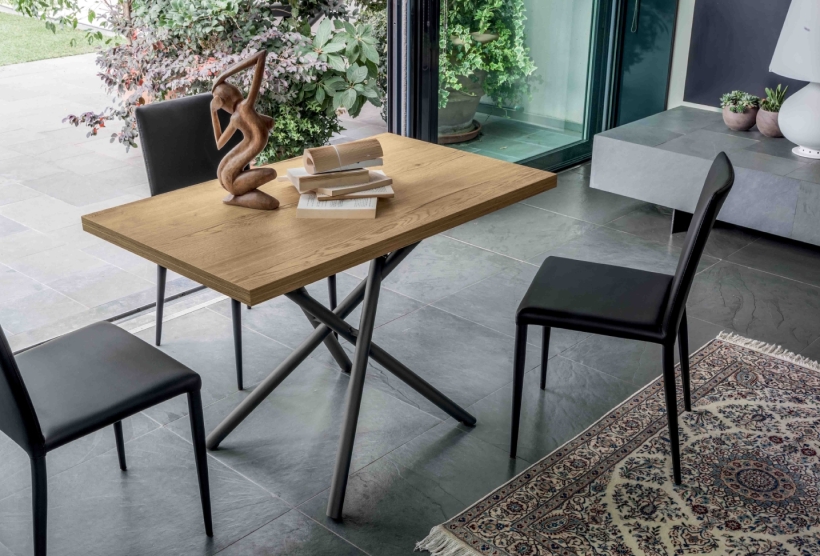
There is a particular satisfaction that comes from a room where everything has a reason — where no piece is merely filling space, where every surface serves something. The Pivot belongs in such rooms. Not because it declares itself, but because it earns its place quietly, every single day.
The Pivot Extending Coffee Table is available to view in Furl’s London and Nottingham showrooms. The mechanism is best understood in person.
A coffee table that converts to a dining table — like the Pivot — uses a gas-assisted mechanism to lift from a low living-room height to full dining height, while the tabletop extends to create a larger surface. The result is one piece of furniture that does the job of two, without permanently occupying the floor space of either.
The Pivot uses a gas-assisted piston mechanism concealed within the steel frame. You lift the tabletop with one hand and guide it to the height you need — it rises smoothly and holds at any point, with no locking required. The mechanism is fully hidden, so nothing interrupts the clean lines of the table at any height.
Yes — the Pivot extends to comfortably seat six. At coffee-table height it sits as a generous centrepiece for a living room. Raised to dining height and extended, it becomes a proper dining table with enough surface for six place settings, without needing to bring in any additional furniture.
The Pivot is built around a solid steel frame that remains completely stable at every height. There is no wobble or flex whether it’s being used as a coffee table, a desk, or a dining table for six. Integrated castors allow you to reposition it easily, then lock it securely in place before use.
The best option for a small living room is one that works harder than a standard coffee table — serving as a workspace, dining table, and living-room surface as needed. An extending coffee table like the Pivot gives you all of that in a compact footprint, without the visual bulk of having separate pieces of furniture competing for the same space.
Not if it’s designed to replace one — which the Pivot is. Most homes that use the Pivot as their primary dining surface find the separate dining table unnecessary. The space it frees up — both visually and physically — is often the point. One well-made piece, doing what several mediocre ones could not.