GUIDES · SMALL SPACE LIVING

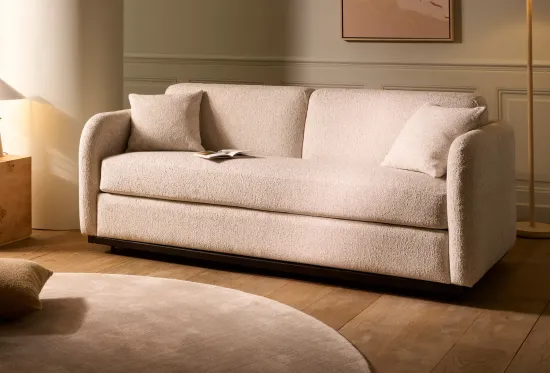
Please note: we no longer make wall beds. Here is why, and what we recommend instead. If you are short on space, a Furl sofa bed gives you a proper bed with a real mattress, and a sofa the rest of the time.


Do you know the difference between a Murphy wall bed and a Furl wall bed? Before we go any further, do you know what a Murphy wall bed is? This blog post looks at the two types of fold-down beds and how they differ. 

What is a Murphy wall bed?

A Murphy bed is also called a wall bed, a pull-down bed, and a fold-down bed. Its name comes from the man who designed it –  William Lawrence Murphy (1876 – 1959) 

It’s believed that Murphy was an opera singer, who lived in a small one-room apartment in San Francisco. At the time it was frowned upon for a woman to enter a man’s bedroom, and this led Murphy to invent a bed that could be folded away easily.

With this invention, he could quickly convert his bedroom into a parlor and entertain female guests without breaking any moral codes.

Although fold-down beds were already available to purchase before Murphy invented his bed in 1912, his design was the first to include pivot and counterbalanced mechanisms, for which he received a series of patents.

Why do people still call them Murphy beds?

Murphy beds are a little bit like a ‘Hoover’, as in a vacuum cleaner. Not many people know that Hoover is actually a brand name. And it was a very well-known brand too. It’s normal to refer to your vacuum cleaner as a hoover because it’s a name that everyone recognises.

Murphy wall beds are sort of similar. They were a very well-known brand of wall beds in America, although in the UK Murphy beds were not generally known as such.

The key word here though is were. The original Murphy Bed company no longer exists. 

How our wall beds differed from the original Murphy bed

1. The weight

Murphy wall beds were known for being incredibly heavy to lift. The mechanisms available in 1912 were very different from today's. Our wall beds used gas pistons, which made them easy to open and close.

2. The quality

Modern folding wall beds use similar engineering principles to Murphy's bed, but the mechanisms have improved a lot.

We used a steel mechanism with bolted gas pistons (which could be changed) and laminated beech slats, so it felt like sleeping on a normal bed frame.

3. The mattress depth

Most wall beds only take specially made mattresses, often with just one option that has to be bought with the mechanism.

Ours took any mattress up to 22cm deep, so you could choose your own.

4. Internal storage

Murphy beds were only designed to store a mattress. As storage specialists, we went one step further and made a wall bed with storage inside.

It was called Vertico, and it had two 25cm deep shelves and a storage box for pillows and a duvet.

5. The finished look

Murphy beds were designed to look like cupboards. We also wanted you to use the floor space in front of the bed when it was closed, so we offered a desk or shelves.

Why we stopped making Murphy wall beds

A wall bed has to be fixed to a wall, takes up that whole wall, and needs folding away every morning. Over time we found a good sofa bed does the same job better: a proper bed with a real mattress up to 18cm deep at night, and a comfortable sofa the rest of the time. No installation, and no wall to give up.

We explain more in why we stopped selling wall beds.

Foldable Murphy Wall Beds vs Sofa Beds

If you're short on space, have a look at our sofa beds as a great alternative to Murphy beds, handmade to order in Nottingham. Or come and try them at our London showrooms. You don't need an appointment.

Wall bed with storage
David Norman, founder of Furl
David Norman

David Norman is the founder of Furl, a UK-based furniture brand known for redefining how people live with space-saving, design-led storage beds and sofa beds.

With almost two decades of hands-on experience in product design, manufacturing, and brand strategy, David has built Furl into a trusted name among urban professionals seeking calm, clutter-free homes. His work has been recognised for its innovation and craftsmanship, with features in publications such as MSN and The Telegraph.

David continues to lead Furl’s creative direction, developing furniture that solves real-world problems without compromise.